

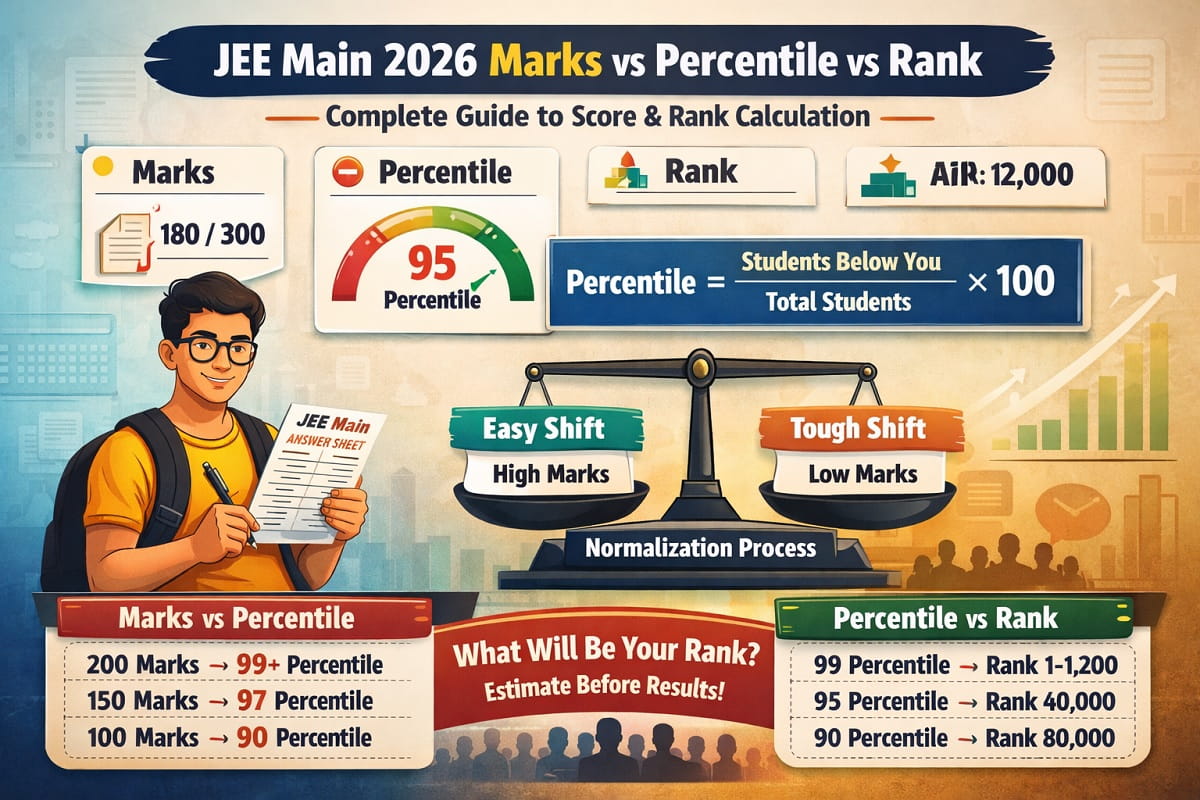
JEE Main 2026 results are finally out, and many students are confused about marks vs percentile vs rank. Why does someone with lower marks get a better rank? How is percentile calculated? And how can you estimate your rank before results?
What is Marks, Percentile & Rank in JEE Main 2026?
1. Marks (Raw Score)
- This is your actual score out of 300
- Based on:
- +4 for correct answer
- -1 for wrong answer
- 0 for unattempted
Example: If you score 180 marks, that is your raw score.
Percentile (Most Important)
- Percentile shows how many students you performed better than
- It is NOT percentage
- It is calculated shift-wise using normalization
Example:
- 95 percentile = You performed better than 95% students
Important: Rank is based on percentile, not marks
Rank (AIR – All India Rank)
- Final position among all students in India
- Prepared after combining all sessions
- Depends on:
- Percentile
- Number of candidates
Why Marks ≠ Percentile in JEE?
Because of normalization system by NTA:
- Different shifts have different difficulty levels
- Easy shift – higher marks needed
- Tough shift – lower marks needed
That’s why:
- 200 marks in easy shift ≠ 200 marks in tough shift
NTA uses percentile to make it fair for everyone
JEE Main 2026 Expected Marks vs Percentile
| Marks (Out of 300) | Expected Percentile |
|---|---|
| 240+ | 99.9+ |
| 210–240 | 99.5–99.9 |
| 180–210 | 99–99.5 |
| 150–180 | 97–99 |
| 120–150 | 95–97 |
| 100–120 | 90–95 |
| 70–100 | 80–90 |
Example:
- 150 marks ≈ 97–98 percentile
JEE Main 2026 Percentile vs Rank (Expected)
| Percentile | Expected Rank |
|---|---|
| 99.9+ | 1 – 1,200 |
| 99 | 8,000 – 12,000 |
| 98 | 15,000 – 20,000 |
| 95 | 40,000 – 50,000 |
| 90 | 80,000 – 1,00,000 |
Rank depends on total candidates each year
Marks vs Rank Examples (Easy Understanding)
- 220 marks – Rank ~ 1,800–3,000
- 170 marks – Rank ~ 9,000–13,000
- 120 marks – Rank ~ 30,000–50,000
- 100 marks – Rank ~ 60,000–80,000
Important Points You Must Know
- Percentile is more important than marks
- Rank is based on percentile, not marks
- Same marks can give different percentile
- Normalization makes exam fair
- Top rank needs 99+ percentile
How to Calculate Your JEE Main 2026 Score
Step 1:
Check your response sheet
Step 2:
Apply marking scheme:
- +4 correct
- -1 wrong
Step 3:
Estimate percentile using previous trends
Step 4:
Convert percentile – rank using table
What is a good score for JEE Main 2026?
- 250+ marks – Top rank (IIT chance)
- 180+ marks – Good NIT
- 120+ marks – Decent college
- 90+ marks – Qualifying range
Frequently Asked Questions (FAQs)
1. What is the difference between marks and percentile in JEE Main 2026?
Marks are your actual score out of 300, while percentile shows how many students you performed better than. Percentile is used to calculate your rank, not marks.
2. Why do the same marks give different percentiles?
Because each shift has a different difficulty level. The normalization process adjusts scores to ensure fairness, so the same marks can result in different percentiles.
3. Is rank based on marks or percentile in JEE Main?
Rank is based on percentile, not marks. The higher your percentile, the better your All India Rank (AIR).
4. What is a good percentile in JEE Main 2026?
- 99+ percentile – Excellent (Top colleges like NITs/IITs)
- 95–99 percentile – Good rank
- 90–95 percentile – Average performance
5. How many marks are needed for 99 percentile?
Generally, around 180–200 marks are required for 99 percentile, depending on exam difficulty and shift.
6. What rank can I get with 95 percentile?
A 95 percentile usually corresponds to a rank between 40,000 to 50,000, depending on total candidates.
7. Can I predict my rank before results?
Yes, you can estimate your rank using:
- Your raw score
- Previous year trends
- Expected marks vs percentile data
However, exact rank depends on normalization and total candidates.
8. What is normalization in JEE Main?
Normalization is a process used by NTA to adjust scores across different shifts to ensure fairness, as some shifts may be easier or harder than others.
9. Does higher marks always mean better rank?
Not always. Due to normalization, a student with slightly lower marks in a tougher shift can get a better percentile and rank.
Final Conclusion
Understanding marks vs percentile vs rank is very important for JEE Main 2026. Always remember:
- Marks show your score
- Percentile shows your competition level
- Rank decides your college
So don’t panic if marks look low — percentile is the real game changer.
