

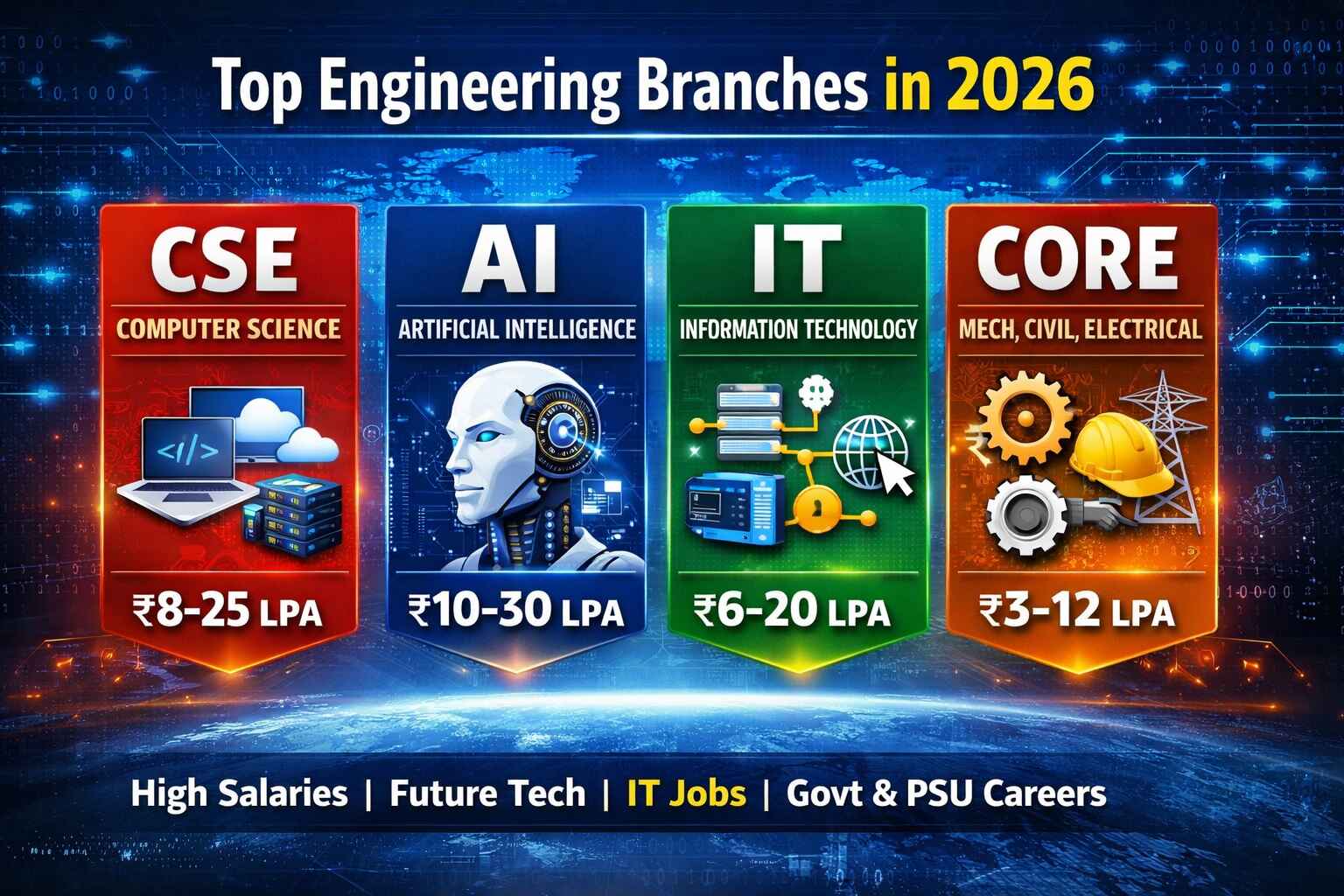
Choosing the right engineering branch in 2026 is one of the most important decisions for students after Class 12. With the rapid growth of technology, branches like Computer Science, Artificial Intelligence, and Information Technology are becoming very popular, while core branches like Mechanical, Civil, and Electrical Engineering still offer strong career opportunities. In this article, we will compare CSE vs AI vs IT vs Core Engineering to help you choose the best engineering branch in 2026.
Top Engineering Branches in 2026 – Complete Guide
Engineering is no longer limited to traditional branches. New technology fields like Artificial Intelligence, Data Science, Cybersecurity, and Robotics are growing very fast. Companies are offering high salary packages especially to students from computer-related branches.
However, core engineering branches are still very important for government jobs, PSUs, and manufacturing industries.
So, the best branch depends on:
- Interest
- Salary expectations
- Job opportunities
- Future scope
- Government job preparation
- Higher studies plans
Comparison Table – CSE vs AI vs IT vs Core Branches
| Branch | Full Name | Difficulty Level | Salary (Average) | Jobs | Future Scope |
|---|---|---|---|---|---|
| CSE | Computer Science Engineering | Medium | ₹8–25 LPA | Very High | Excellent |
| AI | Artificial Intelligence | Medium | ₹10–30 LPA | Very High | Excellent |
| IT | Information Technology | Easy–Medium | ₹6–20 LPA | High | Very Good |
| Mechanical | Mechanical Engineering | Hard | ₹4–12 LPA | Medium | Good |
| Civil | Civil Engineering | Medium | ₹3–10 LPA | Medium | Good |
| Electrical | Electrical Engineering | Hard | ₹4–14 LPA | Medium | Good |
Computer Science Engineering (CSE)
Computer Science Engineering is the most popular engineering branch in India in 2026. Most students prefer CSE because of high salary packages and job opportunities.
Subjects in CSE
- Programming
- Data Structures
- Algorithms
- Operating System
- Database
- Artificial Intelligence
- Machine Learning
- Cloud Computing
- Cyber Security
Top Jobs after CSE
- Software Developer
- Data Scientist
- AI Engineer
- Cyber Security Expert
- Web Developer
- App Developer
- Cloud Engineer
Salary After CSE
- Average Salary: ₹8 LPA – ₹25 LPA
- Top College Salary: ₹30 LPA – ₹1 Crore+
Best Branch if you want high salary and private jobs.
Artificial Intelligence Engineering (AI)
Artificial Intelligence is one of the fastest growing fields in the world. AI engineers are in very high demand in 2026 and this demand will increase in the future.
Subjects in AI
- Machine Learning
- Deep Learning
- Python Programming
- Neural Networks
- Data Science
- Robotics
- Natural Language Processing
- Computer Vision
Top Jobs after AI
- AI Engineer
- Machine Learning Engineer
- Data Scientist
- Robotics Engineer
- AI Researcher
Salary After AI
- Average Salary: ₹10 LPA – ₹30 LPA
- Experienced Salary: ₹40 LPA+
Best Branch for future technology and high salary.
Information Technology (IT)
Information Technology is very similar to Computer Science but slightly easier than CSE. IT focuses more on software, networking, databases, and web technologies.
Subjects in IT
- Programming
- Database Management
- Networking
- Web Development
- Cloud Computing
- Cyber Security
Top Jobs after IT
- Software Developer
- System Engineer
- Network Engineer
- Web Developer
- Database Administrator
Salary After IT
- Average Salary: ₹6 LPA – ₹20 LPA
Best Branch for students who want software jobs but easier syllabus than CSE.
Core Engineering Branches
Core engineering branches include:
- Mechanical Engineering
- Civil Engineering
- Electrical Engineering
- Electronics Engineering
These branches are best for:
- Government Jobs
- PSU Jobs
- Engineering Services (ESE)
- GATE Exam
- Manufacturing Industry
- Construction Industry
Salary in Core Branches
- Average Salary: ₹3 LPA – ₹12 LPA
- Government Jobs: ₹8 LPA – ₹18 LPA
Best Branch for government jobs and PSU careers.
Which Engineering Branch is Best in 2026?
| Goal | Best Branch |
|---|---|
| Highest Salary | AI / CSE |
| Software Jobs | CSE / IT |
| Government Jobs | Mechanical / Civil / Electrical |
| Future Scope | AI / Data Science / CSE |
| Easy Branch | IT |
| Startups | CSE / AI |
| Abroad Jobs | CSE / AI |
| PSU Jobs | Electrical / Mechanical |
| Construction Field | Civil Engineering |
Also Check: Top 5 Best Universities in India As Per NIRF Rankings 2026
Future Scope of Engineering Branches (2026–2035)
Branches with Highest Future Scope
- Artificial Intelligence
- Data Science
- Computer Science
- Cyber Security
- Robotics Engineering
- Cloud Computing
- Electronics Engineering
- Electrical Engineering
Mechanical and Civil will always exist but growth will be slower compared to AI and CSE.
Final Conclusion – Best Branch Selection Strategy
If you are confused between CSE vs AI vs IT vs Core, follow this simple rule:
- If you like coding – Choose CSE or AI
- If you want high salary – Choose AI or CSE
- If you want easier syllabus – Choose IT
- If you want government job – Choose Core branches
- If you want future technology field – Choose AI
- If you want safe branch – Choose CSE
Simple Ranking (Best Engineering Branches 2026)
- Artificial Intelligence
- Computer Science Engineering
- Information Technology
- Electronics Engineering
- Electrical Engineering
- Mechanical Engineering
- Civil Engineering
FAQ – Top Engineering Branches in 2026
Q1. Which engineering branch is best in 2026?
Artificial Intelligence and Computer Science Engineering are the best branches in 2026 due to high salary and job demand.
Q2. CSE vs AI which is better?
AI is better for future technology, but CSE is safer and has more job opportunities.
Q3. Is IT better than CSE?
CSE is better than IT, but IT is easier and still offers good job opportunities.
Q4. Which engineering branch has highest salary?
Artificial Intelligence, Data Science, and Computer Science Engineering have the highest salary packages.
Q5. Which engineering branch is best for government jobs?
Mechanical, Civil, and Electrical Engineering are best for government jobs and PSU jobs.
