

For Indian engineering students, one of the most significant tests is the Graduate Aptitude Test in Engineering (GATE). Every year, a large number of candidates take this exam to get admission to M.Tech programs in IITs, NITs, IIITs, and other top institutes. Many students also use their GATE score to apply for jobs in Public Sector Undertakings (PSUs).
One common question that many students search for is about the GATE admission cutoff. Knowing the cutoff marks can help candidates understand their chances of getting admission to their preferred college and branch. It also gives them an idea of the score they should aim for in the exam.
What is the GATE Admission Cutoff?
The GATE admission cutoff refers to the minimum score required to get admission into postgraduate engineering programs like M.Tech or ME in institutes such as IITs, NITs, and GFTIs.
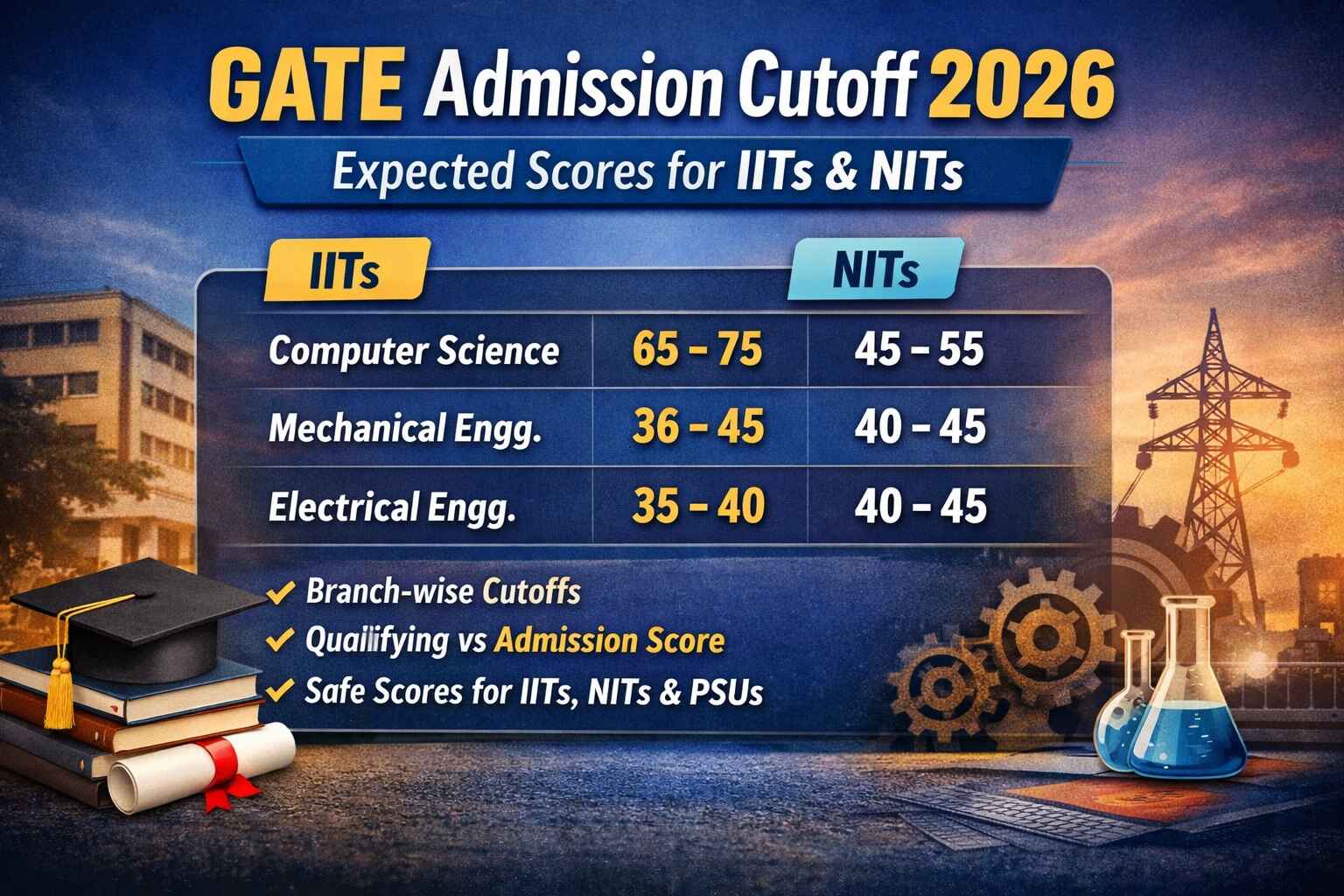
It is important to understand that the admission cutoff is different from the qualifying cutoff announced with the exam results. The qualifying cutoff simply means you have passed the exam, while admission cutoffs are usually much higher because they depend on competition and seat availability.
For example, a candidate might qualify for GATE with around 25–35 marks, but admission to top IITs may require 55–65 marks or even higher depending on the branch.
Expected GATE 2026 Cutoff for IIT M.Tech Admission
Top IITs usually have the highest cutoff scores due to intense competition and limited seats. Popular branches like Computer Science, Electrical Engineering, and Electronics generally have higher requirements.
| Branch | Expected GATE Marks for IITs |
|---|---|
| Computer Science (CSE) | 65 – 75 |
| Data Science & AI | 60 – 70 |
| Electronics & Communication (ECE) | 70 – 80 |
| Mechanical Engineering (ME) | 36 – 45 |
| Electrical Engineering (EE) | 35 – 40 |
| Civil Engineering (CE) | 35 – 40 |
For top institutes like IIT Bombay, IIT Delhi, and IIT Madras, candidates often need GATE scores above 700–800 to secure admission in highly competitive programs.
Expected GATE Cutoff for NIT M.Tech Admission
Admissions to NITs are conducted through CCMT counselling, and the cutoff is slightly lower compared to IITs. However, popular NITs still require strong scores.
| Branch | Expected Marks for NIT Admission |
|---|---|
| Computer Science (CSE) | 45 – 55 |
| Data Science & AI | 45 – 55 |
| Electronics & Communication | 40 – 45 |
| Mechanical Engineering | 40 – 45 |
| Civil Engineering | 40 – 45 |
Generally, a GATE score of 650–750 is considered safe for top NITs, while 500–600 may work for mid-tier NITs.
GATE Qualifying Cutoff vs Admission Cutoff
Many candidates get confused between qualifying marks and admission cutoff. The table below explains the difference clearly.
| Factor | GATE Qualifying Cutoff | GATE Admission Cutoff |
|---|---|---|
| Purpose | Passing the exam | Getting admission to institutes |
| Marks Required | Around 25–35 marks | Much higher (40–70+ depending on branch) |
| Released by | GATE conducting authority | Individual institutes |
| Importance | Eligibility for M.Tech or PSU applications | Determines admission chances |
Simply qualifying GATE does not guarantee admission into IITs or NITs; candidates must score significantly higher than the qualifying marks.
Previous Year GATE Cutoff Example
Here is an example of branch-wise qualifying cutoffs from a previous year to give an idea of how they vary.
| Branch | General | OBC/EWS | SC/ST/PwD |
|---|---|---|---|
| Computer Science | 27.6 | 24.8 | 18.4 |
| Civil Engineering | 28.3 | 25.4 | 18.8 |
| Mechanical Engineering | 35.8 | 32.2 | 23.8 |
| Electrical Engineering | 25.7 | 23.1 | 17.1 |
| Electronics & Communication | 25 | 22.5 | 16.6 |
These values change every year depending on exam difficulty and candidate performance.
Factors That Affect GATE Cutoff
Several factors influence the GATE cutoff each year. Some of the most important factors include:
1. Difficulty Level of the Exam
If the exam paper is tough, the cutoff tends to decrease. The cutoff typically rises if the exam is simpler.
2. Number of Candidates Appearing
Higher participation in the exam increases competition, which can push cutoffs higher.
3. Number of Seats Available
Limited seats in IITs and NITs increase the competition for admission.
4. Candidate Performance
The cutoff automatically rises if many applicants receive high scores.
5. Reservation Policies
Category-wise reservations also influence cutoff scores for different groups.
Safe GATE Score for IITs, NITs, and PSUs
The following table gives a rough idea of what score range is considered safe for different opportunities.
| Goal | Safe GATE Marks |
|---|---|
| Just qualifying GATE | 28 – 32 |
| Admission in NITs | 40 – 50 |
| Admission in IITs | 55 – 65+ |
| PSU Recruitment | 65 – 80+ |
Scoring above these ranges significantly increases your chances of getting into top institutes or securing a PSU job.
Final Thoughts
Understanding the GATE admission cutoff is essential for planning your preparation strategy. While qualifying marks help you pass the exam, the actual admission cutoff determines whether you can enter prestigious institutes like IITs or NITs.
Aspirants should aim to score well above the qualifying cutoff, especially if they want admission to top engineering institutes or PSU recruitment opportunities.
Consistent preparation, solving previous years’ papers, and focusing on conceptual clarity can greatly improve your chances of scoring a high GATE rank.
